Interactive art mishaps can turn a festival installation into a safety incident, a damaged artwork, or an unexpected public spectacle. They also reveal where creative ambition meets real-world limits: crowd behavior, weather, accessibility, engineering, and emergency planning. From a fire-damaged sculpture at Burning Man to a collapsed festival sculpture in the United Kingdom, past incidents show how festivals can learn to test installations, communicate risks, protect audiences, and plan for failure without abandoning experimentation.
Festival interactive art mishaps and the lessons they teach
Interactive festival art invites people to touch, climb, enter, move, or otherwise change an artwork. That participation makes the audience part of the experience—and part of the operating environment. A mishap may be a minor malfunction, an artwork damaged by visitors, or an injury-producing structural failure. The useful lesson is not that every installation is dangerous; it is that artworks designed for public interaction need safety practices suited to their actual use, rather than assumptions based on how they look in a studio.
There is no single, reliable global database of festival art accidents, so a comprehensive incident rate cannot be stated. Public case reports instead offer specific warnings. In 2014, a temporary sculpture associated with the Secret Garden Party festival collapsed in strong winds, killing two people and injuring others. In 2007, a fire at Burning Man destroyed the large wooden “Man” sculpture before the planned ceremonial burn; organizers treated it as an arson incident and rebuilt the figure. These events differed sharply in cause and consequence, but both demonstrate why festivals need contingency plans for artworks that are exposed to weather, crowds, fire, or deliberate interference.
Public interaction as an attribute of festival art
“Interactive art” has no universally binding safety definition. In practical festival planning, it describes work in which a visitor’s movement, touch, choices, or input changes the experience or operation of the piece. Art historian and curator Claire Bishop, in Artificial Hells, examines participatory art as work that makes audience involvement central rather than incidental. For festival producers, that distinction has a practical consequence: a structure that audiences are invited to climb or enter must be assessed as an occupied public environment, not merely as a display.
Interactive installations include several related forms: participatory sculptures, walk-through environments, climbable structures, responsive light or sound works, and temporary kinetic or mechanically operated pieces. Their risks vary. A sensor-based artwork may primarily need electrical and crowd-flow controls, while an installation that supports people’s weight also needs structural design, inspection, and clear limits on use. The shared requirement is to define what visitors are expected to do—and what could happen if they do more.
Participatory and climbable sculptures
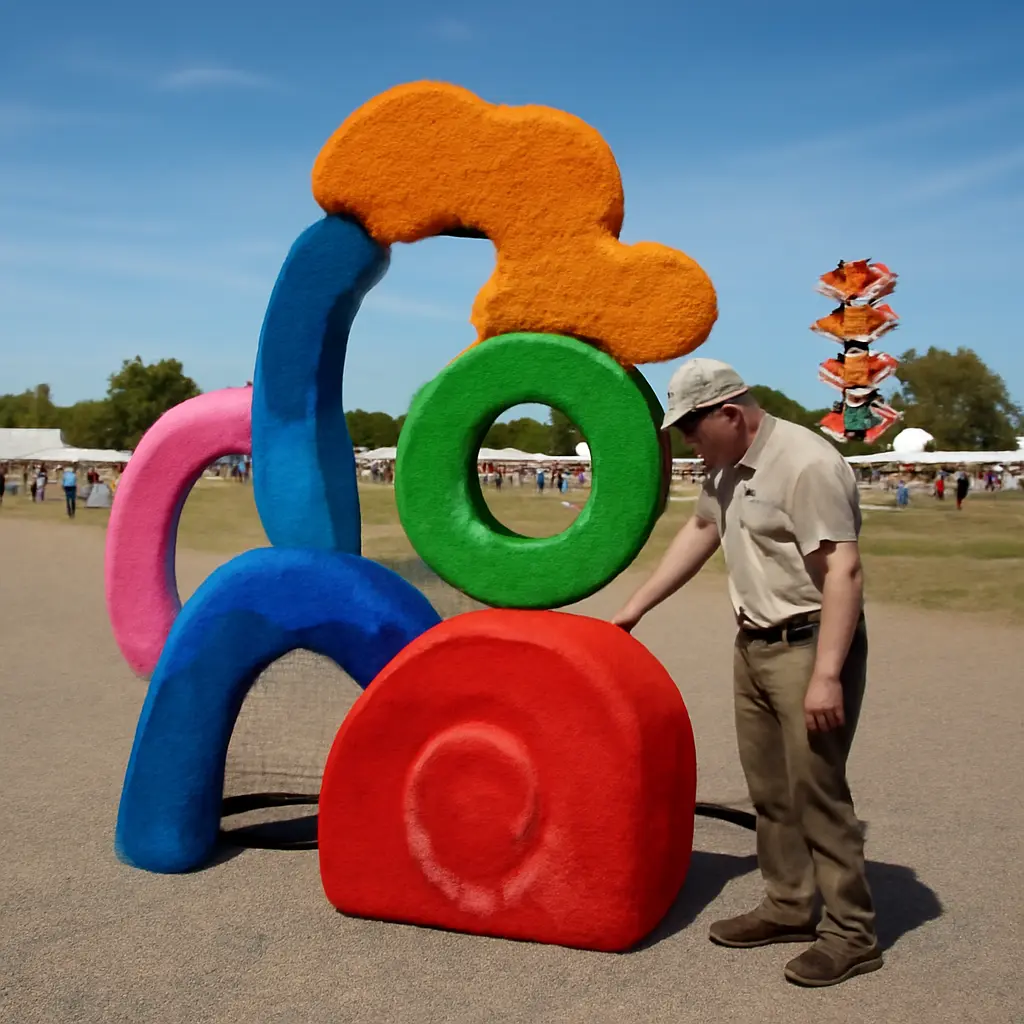
Participatory sculpture allows visitors to handle, enter, or physically alter a work. Climbable art adds fall, crushing, and structural-load hazards. The distinction between “people may approach it” and “people may climb it” must be explicit: an inviting shape can prompt climbing even when the artist did not intend it. Organizers should agree in advance on permitted activities, maximum occupancy where relevant, inspection responsibilities, and whether barriers or staff are needed.
The 2014 Secret Garden Party incident illustrates the severity of structural failure at an event. The BBC reported that a temporary sculpture collapsed during high winds, killing two people and injuring others. The tragedy was not simply a matter of audience interaction; it showed that public artworks can become hazards when environmental conditions exceed what a temporary structure can withstand. Weather limits, evacuation criteria, and a designated person empowered to close an installation are therefore essential parts of its operating plan.
Responsive, kinetic, and electrically powered work
Responsive installations use sensors, lights, sound, motors, or other equipment to react to visitors. Kinetic work moves mechanically, whether automatically or through participant input. These categories create risks that are less visible than a structure’s height: exposed cables, pinch points, unexpected movement, overheating, trip hazards, or confusing feedback that encourages unsafe behavior. A technical test should include ordinary operation, foreseeable misuse, shutdown procedures, and what happens after power or communications fail.
The UK Health and Safety Executive’s event-safety guidance emphasizes planning, risk assessment, and clear responsibility for managing hazards at events. Applied to interactive work, that means artists, engineers, venue operators, and event safety staff should establish who can stop the piece, who checks it, and how faults are reported. A malfunction should not depend on a visitor finding the right person by chance.
Temporary monumental and fire-based artworks
Large temporary artworks and burnable sculptures combine spectacle with risks from wind, fire, crowd proximity, and the short life cycle of the structure. Burning Man’s 2007 “Man” fire is a notable example: the structure was burned prematurely in an arson incident, days before its planned ritual. The festival rebuilt it, but the incident underscored that symbolic centerpiece artworks need security, fire planning, and a fallback plan—not only a dramatic design.
Fire-based art should be planned with local fire authorities and competent safety professionals, with control zones, ignition procedures, emergency access, and a clear method for stopping or delaying the event. Organizers should also communicate what spectators may do, where they may stand, and how conditions such as wind affect the plan. A spectacle’s cultural importance does not reduce the need for operational limits.
What festival mishaps teach organizers
The incidents above point to a common principle: safety depends on the relationship between design, setting, and audience behavior. An installation can be sound in one location and unsuitable in another because of wind exposure, ground conditions, crowd density, or the way people interpret its invitation to participate. Lessons are most useful when translated into decisions made before the public arrives.
Design for foreseeable behavior, not ideal behavior
Visitors may climb a surface that looks climbable, lean on a barrier, gather around an interactive control, or use a work differently from what its maker intended. A practical review asks what a curious, excited, tired, or intoxicated visitor might do, and whether the installation remains safe under those foreseeable conditions. Instructions and signs help, but they cannot substitute for a design that limits the consequences of predictable misuse.
The UK Health and Safety Executive recommends assessing risks and putting suitable controls in place as part of event planning. For interactive art, controls may include structural review, guarding moving parts, accessible routes, supervised operation, capacity limits, or removing an invitation to climb. These measures should be proportionate to the work, not applied as a one-size-fits-all checklist.
Use weather thresholds and stop-work authority
Outdoor installations should have documented operating limits for wind, rain, heat, and other relevant conditions. Organizers need a monitoring method and a named decision-maker with authority to close, cordon off, or dismantle an artwork. The Secret Garden Party collapse shows why waiting until a structure visibly fails is not an acceptable weather strategy. A clear threshold turns a vague concern into an actionable trigger.
A weather plan should also address what happens after closure: how visitors are redirected, who secures the area, whether the artwork can be stabilized, and how staff communicate the decision. Forecasts and on-site observations are complementary; the plan should account for changing conditions during the festival, not just the forecast made during installation.
Test, inspect, and rehearse failure
A successful workshop test does not prove that an artwork is ready for a crowded festival. Testing should reflect the real installation, expected audience interaction, power supply, ground conditions, and operating duration. Inspection schedules should specify who checks the work, what they look for, and how defects are recorded and escalated. For powered or moving pieces, organizers should test emergency shutdowns and safe states.
The same discipline applies to contingency planning. The 2007 Burning Man fire demonstrates the value of having an alternative when a centerpiece is damaged or lost. Rebuilding was possible in that instance, but other works may require cancellation, substitution, or a change in public programming. A fallback plan protects audiences and helps prevent pressure to keep an unsafe or compromised installation operating.
Make participation accessible and legible
Safety communication should explain what a visitor can do, where access begins and ends, and how to ask for help. It should be visible, understandable, and designed for people with different mobility, sensory, and language needs. A narrow entrance, ambiguous boundary, or unmarked moving part can create both access barriers and safety problems. Clear routes and instructions can support participation while reducing confusion and crowding.
Accessibility is not an optional addition to interactive art. Organizers should consider whether a work offers meaningful participation to visitors who cannot climb, stand for long periods, hear a sound cue, or reach a control. Alternative ways to engage can preserve the artistic invitation without making one physical ability the price of admission.
A practical planning checklist for interactive installations
Before opening an installation, festival teams can use a short review to connect artistic intent with operational responsibility:
- Describe the intended interaction and identify foreseeable unintended uses.
- Confirm who is responsible for design approval, installation, inspection, operation, and shutdown.
- Assess structural, fire, electrical, mechanical, crowd, weather, and accessibility risks relevant to the work.
- Set clear limits for occupancy, climbing, touching, weather, and operating hours where needed.
- Test the installation in its actual configuration and rehearse power loss, equipment failure, evacuation, or closure.
- Provide visible instructions, staff escalation routes, and a way to report damage or unsafe behavior.
- Prepare a fallback plan, including whether to repair, close, replace, or cancel the artwork.
This checklist is a starting point, not a replacement for professional engineering advice, local regulations, or venue-specific risk assessment. The appropriate controls depend on the artwork and the people expected to use it.
Conclusion: mishaps can make participation safer
Interactive art makes festivals memorable by inviting audiences to become participants, but that invitation changes the safety demands of the work. Participatory sculptures, responsive installations, kinetic pieces, and monumental fire-based artworks each bring different hazards. The Secret Garden Party collapse and Burning Man’s 2007 sculpture fire show why festival teams need weather limits, clear responsibility, testing, audience communication, and contingency plans.
The broader lesson is not to make public art less adventurous. It is to make experimentation more resilient by planning for real crowds, changing conditions, and failure. Festival organizers and artists can start by documenting how an installation is meant to be used, reviewing foreseeable risks with qualified people, and giving staff authority to pause it. For further guidance, consult the UK Health and Safety Executive’s event-safety resources and local authorities responsible for structural, fire, and public-event safety.
Sources: BBC News, “Two killed as sculpture collapses at Secret Garden Party,” 2014, https://www.bbc.com/news/uk-england-cambridgeshire-28394280; The Guardian, “Burning Man statue destroyed in arson attack,” 2007, https://www.theguardian.com/world/2007/aug/29/usa; UK Health and Safety Executive, “Event safety,” https://www.hse.gov.uk/event-safety/; Claire Bishop, Artificial Hells: Participatory Art and the Politics of Spectatorship, Verso, 2012, https://www.versobooks.com/products/132-artificial-hells