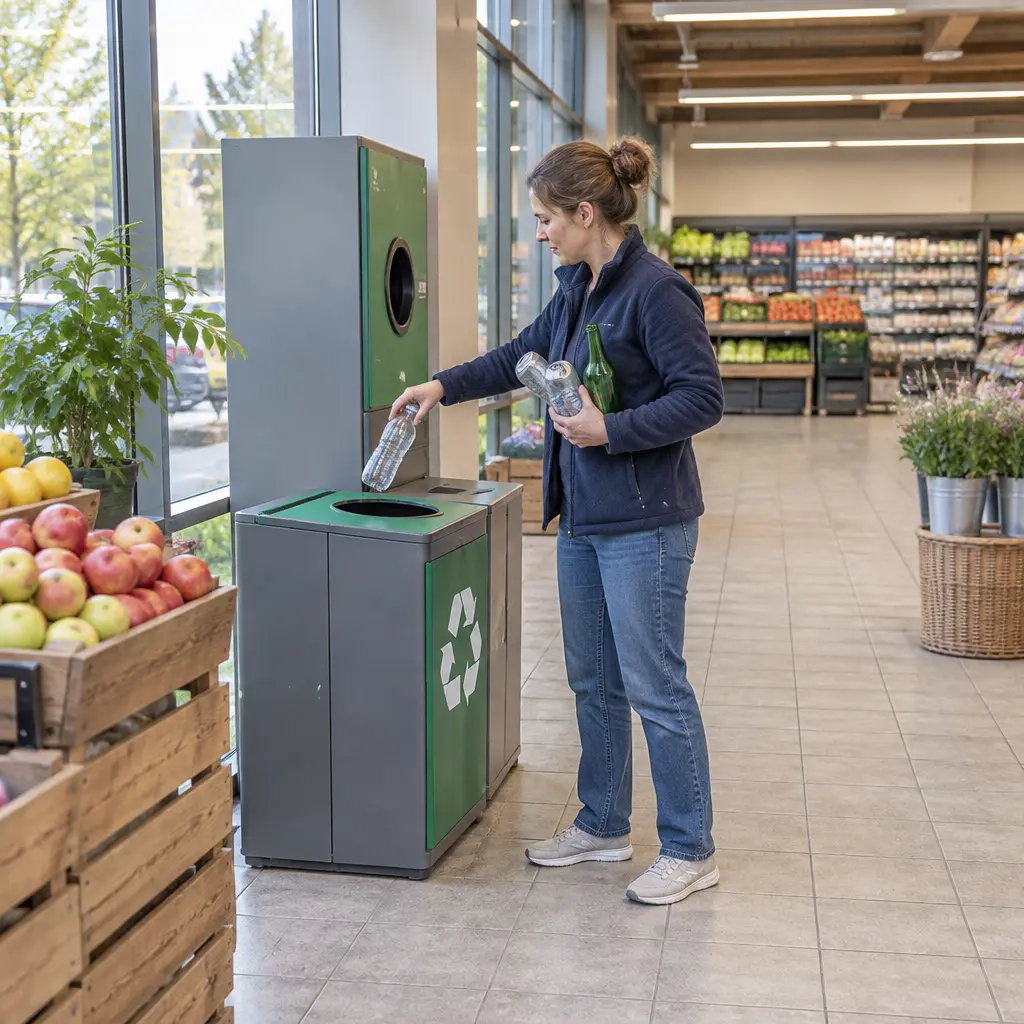
A deposit return scheme (DRS) is a system in which consumers pay a small, refundable deposit when buying a beverage container and receive the money back when they return the empty container for collection and recycling or reuse. By making returns financially rewarding and establishing a dedicated collection route, deposit schemes can reduce litter and help recover containers as cleaner, more traceable material. Their results depend on practical design: deposit value, convenient return points, clear rules, reliable processing, and coordination across producers, retailers, and governments. The experiences of Norway, Germany, and U.S. states show both the potential and the trade-offs, while evidence from the OECD and European Commission highlights why deposits are increasingly relevant to waste prevention and circular-economy operations.
Deposit return schemes define a practical route for reducing single-use waste
A DRS is an economic and operational arrangement that attaches a refundable deposit to a product container. The consumer pays the deposit at purchase and gets it back by returning an eligible empty container to an approved point. The European Commission describes deposit systems as a way to encourage the separate collection of beverage containers; the OECD places them among policy instruments that use financial incentives to influence product and waste-management choices.
The main operational distinction is that containers are collected separately rather than relying solely on mixed household recycling. That can make it easier to identify eligible packaging and preserve material quality. A scheme may collect single-use plastic bottles and metal cans, refillable glass bottles, or a defined combination. Coverage differs by jurisdiction, so a deposit system should not be assumed to include every package or material.
Scale matters. The European Commission’s 2020 assessment reported that 10 EU Member States had deposit systems for single-use beverage containers at that time. The European Union’s Single-Use Plastics Directive set a separate collection target of 77% for plastic beverage bottles by 2025 and 90% by 2029. These targets do not mean every country must use a DRS; they show the collection challenge that well-designed schemes can help address.
Return incentives and collection performance
The deposit is a refundable incentive, not a tax or a purchase surcharge that consumers necessarily lose. The amount must be noticeable enough to motivate returns but designed with affordability and local purchasing conditions in mind. A return rate—the proportion of eligible containers returned through the scheme—is a central performance measure, although reporting methods and coverage can differ between programs.
Norway’s Infinitum, the operator of its beverage-container system, reported a 2023 return rate of 92.3% for deposit-bearing containers. That figure illustrates what mature infrastructure and established consumer habits can achieve; it should not be treated as a guaranteed outcome for a new program. Results also depend on whether the statistic counts containers sold, returned, or otherwise recovered, and on the period measured.
Scheme types and covered containers
DRS designs can be grouped by what happens to the container. A single-use recycling scheme collects containers for material recovery. A refillable-container scheme returns packaging for washing and repeated use. Some jurisdictions operate both, while others cover only selected beverage containers. These are related but distinct approaches: recycling recovers material after use, whereas reuse retains the container as a product or packaging asset for another cycle.
A scheme’s scope should specify eligible materials, container sizes, product categories, and any exemptions. Clear coverage rules reduce confusion for consumers and retailers and help producers label products consistently. They also determine whether a scheme can support broader waste-reduction goals or mainly improve collection of a narrow group of beverage packages.
Deposit return scheme operations depend on accessible returns and accountable logistics
The deposit is only one part of the system. A functioning DRS must connect product registration and deposit payment with consumer returns, retailer or collection-site handling, transport, sorting, and final recycling or reuse. The contextual link between incentive and performance is convenience: consumers cannot redeem deposits easily if return locations are distant, opening hours are limited, or machines frequently reject eligible containers.
Return points and consumer access
Return points may include staffed counters, reverse-vending machines, dedicated collection depots, or approved community locations. Reverse-vending machines scan and accept eligible containers and can issue a refund voucher; staffed systems may be more adaptable for unusual or damaged containers. A balanced network considers population density, rural travel distances, retailer capacity, accessibility for people with disabilities, and options for people without a car.
Retailer obligations vary. Some schemes require stores selling covered drinks to accept returns, while others use minimum sales thresholds or centralized collection sites. Whatever the model, published operating hours, clear signage, and an alternative when a machine is unavailable help protect consumer trust. Return convenience is also an equity issue: people should not face disproportionate time or travel costs to recover a deposit.
Producer responsibility, clearing, and material handling
Producers and importers commonly finance or administer key parts of a DRS, often through a not-for-profit scheme operator or a regulated clearing organization. Producers register eligible products, provide packaging data, and fund system costs through fees. Retailers collect deposits at sale and refund them on return; a clearing process reconciles the money and container flows between businesses.
The operator must account for deposits paid, refunds issued, unredeemed deposits, handling fees, transport, and sales of recovered material. Transparent auditing helps deter fraud and identifies operational gaps. Unredeemed deposits should be treated according to local law and scheme rules rather than assumed to be unrestricted revenue; they may be allocated to administration, public education, or environmental programs.
Data, tracking, and contamination control
Reliable reporting makes it possible to distinguish high return rates from simple changes in sales or collection boundaries. Useful indicators include containers placed on the market, containers returned, redemption rate, rejected-container rate, contamination, material quality, litter counts, operating cost per container, and the share ultimately recycled or reused. The European Commission’s plastic-bottle targets provide a policy benchmark, but local operators need consistent definitions and independently verifiable data to assess progress.
Barcode or product-code validation can help identify eligible containers and prevent duplicate claims, while weight and material checks support downstream quality control. Data systems should also protect commercially sensitive and personal information. Publishing performance in a clear annual report allows governments, businesses, and residents to see whether a scheme is improving collection rather than merely shifting waste between channels.
Deposit return schemes deliver environmental gains when system design fits local conditions
A DRS can support waste reduction by making littering more costly in effect, encouraging returns, and providing a separate stream of recyclable material. However, a deposit scheme does not itself eliminate single-use packaging. Its environmental value depends on what happens after collection, the energy and transport required, the packaging displaced, and whether reusable options are practical. This distinction connects collection performance to the broader waste hierarchy: prevention and reuse generally avoid more material use than recycling alone.
Litter reduction and cleaner material streams
Because containers retain a refundable value, people have a reason to return them, and others may collect discarded containers for redemption. This mechanism can reduce beverage-container litter, though outcomes vary with deposit value, enforcement, public-space access, and baseline litter conditions. Separately collected bottles and cans are generally easier to identify than packaging mixed with other household waste, which can support higher-quality recycling feedstock.
Litter impacts should be evaluated with comparable surveys before and after implementation, not inferred from return rates alone. A high redemption rate is evidence that containers are coming back through the system, but it does not reveal whether total packaging consumption has fallen or whether litter has shifted to other items.
Recycling, reuse, and climate implications
Recycling can reduce demand for virgin material when recovered material is actually processed and used in new products. Refillable systems can avoid manufacturing a new single-use container for each purchase, but their overall impacts depend on the number of reuse cycles, washing, transport distances, container weight, and loss or breakage rates. Life-cycle assessment is therefore needed to compare options fairly rather than assuming that one material or collection method is always best.
The European Environment Agency’s analysis of packaging and plastics emphasizes that material use, collection, recycling, and prevention are connected parts of Europe’s circular-economy challenge. For operators, the practical implication is to report final destinations and material yields—not only the number of containers accepted at return points—and to assess whether reuse can complement or replace single-use formats.
Costs, participation, and unintended effects
Operating costs include machines or staffed counters, storage, transportation, sorting, software, communication, and audit. Businesses may also need space and labor for handling returned containers. Deposits can affect consumer cash flow, especially when returns are inconvenient, so scheme design should ensure that redemption is straightforward and refunds are timely.
Potential problems include fraud across jurisdictions, confusion over eligible packaging, machine downtime, excessive travel, and competition or overlap with municipal recycling systems. These risks can be reduced through interoperable rules, clear labeling, accessible return options, strong reconciliation controls, and consultation with local authorities and retailers. The OECD’s policy work on extended producer responsibility stresses that clear responsibilities and effective oversight are essential to making producer-funded systems work.
Deposit return scheme case studies show the importance of context
International examples demonstrate that DRS outcomes reflect institutional history and operational detail, not just the presence of a deposit. Comparing mature programs with newer policies can help decision-makers identify design choices, while avoiding direct comparisons between systems with different container coverage, return-rate definitions, or infrastructure.
Norway: a mature, producer-operated system
Norway’s Infinitum system combines deposits, extensive return opportunities, and producer participation. Its reported 92.3% return rate for deposit-bearing containers in 2023 is a notable operational result. The case underscores the value of a recognizable national system and convenient retail returns, while also showing why performance statistics must be tied to a named operator, year, and specific definition.
Germany: deposits alongside broader packaging rules
Germany’s one-way beverage-container deposit system operates within a broader packaging and producer-responsibility framework. The deposit applies to specified containers rather than all packaging, and refillable beverage packaging also has a long-standing market presence. Germany illustrates why public communication must distinguish deposit-bearing one-way containers from other packaging routes, and why a DRS is one component of a wider packaging system rather than a complete waste strategy.
United States: a patchwork of state-level bottle bills
In the United States, container-deposit laws are established at the state level, producing variation in covered beverages, deposit amounts, redemption access, and administration. The Container Recycling Institute tracks this state-by-state landscape. The patchwork demonstrates the value of clear labels and compatible rules, while highlighting how fragmented requirements can complicate distribution, consumer understanding, and cross-border reconciliation.
Implementing a deposit return scheme requires measurable goals and public trust
A successful launch begins with a baseline: packaging placed on the market, existing recycling performance, litter conditions, retailer capacity, and the geography of potential return points. Governments and scheme operators can then set goals for collection, material quality, access, cost, and reuse, with a timetable for review. These measures connect policy intent to day-to-day operational accountability.
- Define coverage, deposit values, eligible products, and exemptions in plain language.
- Map convenient return options, including rural and underserved areas, before launch.
- Assign clear roles and financial responsibilities to producers, retailers, operators, and public agencies.
- Establish auditable data standards for sales, returns, refunds, material destinations, and costs.
- Communicate how consumers can redeem deposits and how the program supports recycling or reuse.
- Review results regularly and adjust access, fees, and rules when evidence identifies barriers.
Public trust depends on reliable refunds, transparent finances, accessible service, and credible reporting. Policymakers should also assess the scheme against prevention and reuse goals so that higher collection does not become a substitute for reducing unnecessary packaging. A useful accompanying chart would compare annual containers sold, returned, and recovered, with separate lines for return rate, material yield, and reuse share; this would show whether performance gains extend beyond redemption.
Conclusion: deposit return schemes can strengthen circular operations
Deposit return schemes use a refundable financial incentive and a dedicated collection network to bring eligible containers back into productive use. Their effectiveness rests on accessible return points, clear producer and retailer responsibilities, sound data, and responsible downstream processing. Norway’s reported results show the potential of a mature system, while Germany and U.S. state programs illustrate the need to tailor rules to existing packaging markets and governance.
For businesses and governments seeking to reduce single-use waste, the next step is to evaluate local packaging flows, consult affected communities and retailers, and set measurable targets that include both collection and prevention. A DRS can be a powerful operational tool, but its broader value is greatest when paired with waste reduction, refill and reuse options, and transparent evidence of environmental outcomes.
Sources: European Commission, “Deposit-refund systems and the collection of beverage containers,” 2020, https://environment.ec.europa.eu/topics/waste-and-recycling/packaging-waste_en; European Union, Directive (EU) 2019/904 on the reduction of the impact of certain plastic products on the environment, https://eur-lex.europa.eu/eli/dir/2019/904/oj; Infinitum, “Annual Report 2023,” https://infinitum.no/; OECD, Extended Producer Responsibility: Updated Guidance for Efficient Waste Management, 2016, https://doi.org/10.1787/9789264256385-en; European Environment Agency, Packaging waste, https://www.eea.europa.eu/en/topics/in-depth/waste-and-recycling/packaging-waste; Container Recycling Institute, Bottle Bills, https://bottlebill.org/.