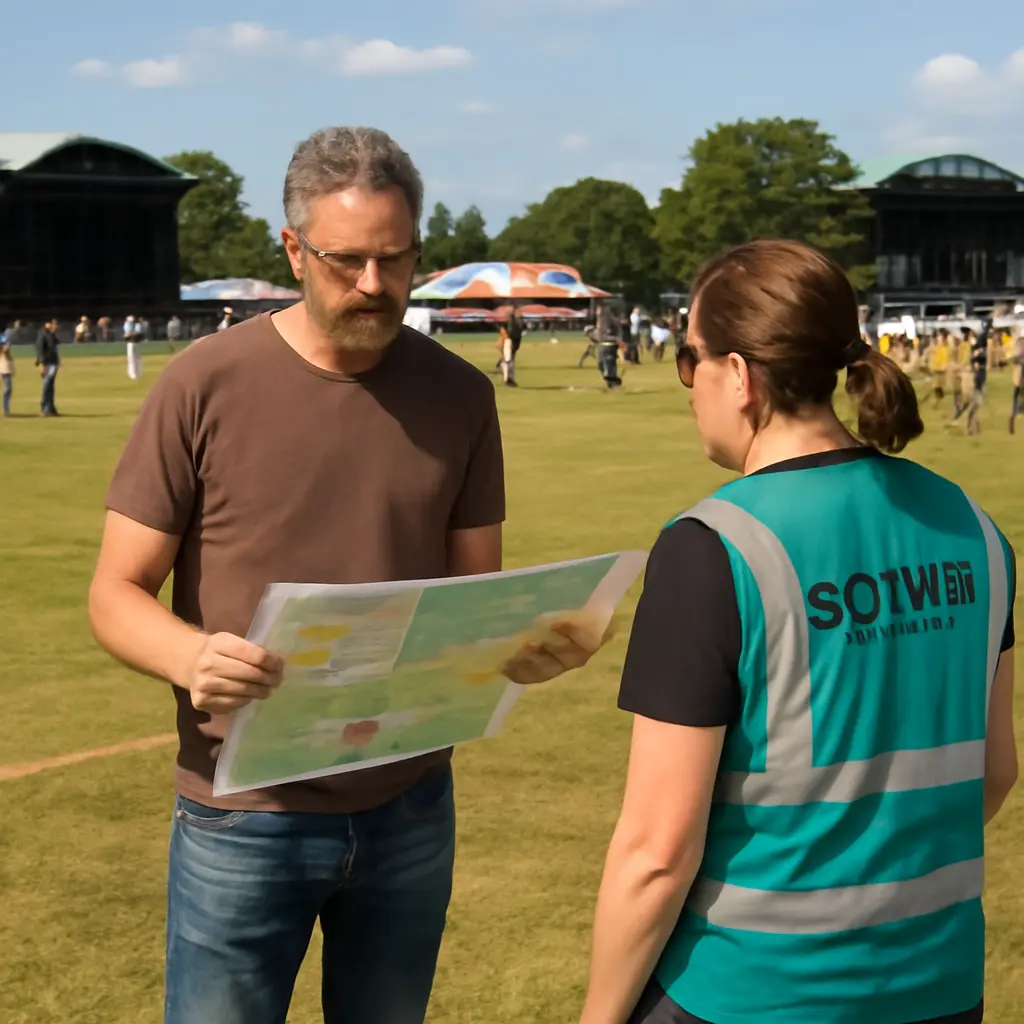
A festival crowd-flow program is the coordinated plan for moving attendees safely and comfortably between entrances, stages, food areas, toilets, and exits throughout an event. It combines site design, timed programming, live monitoring, and clear communication. The need is practical as well as safety-critical: the U.S. National Institute of Standards and Technology’s investigation of the 2003 Station nightclub fire documented how a fast-moving crowd surge toward a limited number of exits contributed to 100 deaths. A well-programmed festival therefore balances audience demand across the day, watches for congestion, and gives staff the means to respond before queues or bottlenecks become dangerous.
Festival crowd programming balances movement, capacity, and safety
Crowd programming means arranging event activities and operational controls so that people can reach destinations without overwhelming routes or facilities. The UK Health and Safety Executive (HSE) describes crowd management as planning and controlling the movement of people, including anticipating crowd behavior, managing entry and exit, and providing suitable facilities. For a festival, the relevant forms include arrival management, audience dispersal between attractions, queue management, and emergency evacuation planning.
The aim is not simply to keep people walking. Attendees need places to pause, socialize, eat, and watch performances. Organizers instead seek to prevent uncontrolled accumulation at pinch points, avoid conflicting flows, and maintain accessible routes. HSE guidance emphasizes that crowd risk depends on factors such as venue layout, event type, audience characteristics, and how people behave—not just the total attendance figure.
That makes the daily schedule part of the site’s safety design. When a headline act ends at the same time as another attraction opens, thousands of people may move at once. Programming can reduce that pressure by staggering set times and offering compelling alternatives across the grounds.
Arrival and entry management
Arrival management is the planning of when and where attendees approach the site, pass through screening, and enter. It includes ticketing arrangements, transport coordination, signage, queue layouts, and enough staffed entry lanes for expected demand. HSE event guidance recommends estimating arrival patterns rather than assuming that ticket holders will arrive evenly throughout the day.
Organizers can spread arrivals with timed activities, early access options, transport information, and pre-event messages that explain which entrance to use. Separate lanes for different ticket types, accessible entry, and security checks can reduce cross-traffic when the layout permits. These measures should be tested against actual site capacity and local emergency plans; a queue that blocks a public road or emergency access route is not a successful queue.
Programming for audience dispersal
Audience dispersal is the deliberate distribution of attractions and performance times so that demand is not concentrated in one place. It can involve staggered stage schedules, roaming performers, family activities, food programming, and quiet or shaded areas in different parts of the venue. These are hyponyms of crowd programming because each applies the broader goal of shaping movement to a particular audience behavior.
A festival with several stages can avoid scheduling every major draw to begin or end simultaneously. It can also create an appealing transition between performances rather than directing everyone toward the same path at once. This is a planning principle, not a guarantee: artist popularity, weather, transport disruptions, and audience preference can change movement patterns, so the schedule must be paired with live observation.
Festival route design connects destinations without creating bottlenecks
Route design is the arrangement of paths, gates, barriers, signs, and circulation areas that determines how people travel through an event. The UK Health and Safety Executive’s event guidance calls for routes and exits to be suitable for the expected numbers and for crowd movement to be considered in the event risk assessment. A route plan should account for ordinary circulation as well as arrival surges, stage changeovers, weather-related diversions, and evacuation.
A useful site plan distinguishes pedestrian routes from vehicle and service access, identifies narrow sections and intersections, and checks that attractions do not obstruct exits. Organizers should also consider where people naturally stop—at food stalls, merchandise points, photo locations, or stage viewing areas—because a clear path on a map can become congested when an activity draws a stationary crowd.
One-way systems and separated flows
A one-way system directs attendees along a route in a single direction, while flow separation keeps groups with different purposes—such as pedestrians, vehicles, and queueing customers—from crossing unnecessarily. These approaches can reduce head-on conflicts and simplify steward instructions, particularly at constrained entrances or around popular attractions.
They must remain understandable and flexible. Signs should be visible before a decision point, and staff should be able to redirect people if a route becomes unsafe. Routes should not trap attendees in a dead end, obstruct accessible travel, or compromise emergency egress. The HSE advises event organizers to make exits and escape routes clear and to avoid arrangements that could create dangerous crowd pressure.
Queues, facilities, and places to pause
Queue management is the design and supervision of waiting areas so that lines remain orderly and do not spill into circulation routes. Toilets, water points, food outlets, and first-aid locations all generate queues, so their placement and capacity affect movement across the whole site. Clear queue boundaries, visible service information, and staff who can identify a growing line help prevent queues from becoming unplanned barriers.
Facilities also influence how long attendees remain in particular areas. Providing seating, shade, and water can support comfort and reduce pressure to move suddenly, while poorly placed facilities may draw people across busy routes. Organizers should review facility demand by time of day and location, and should keep accessible services and routes available rather than treating accessibility as an afterthought.
Live monitoring turns a festival plan into an operational response
Live crowd monitoring is the ongoing observation of attendance, density, queues, and movement during the event. It connects the pre-event risk assessment to decisions made on the ground. The HSE recommends active monitoring and communication among event control, stewards, security, and emergency services, with clear responsibilities for acting on developing problems.
Monitoring methods may include trained staff observations, radio reports, ticket scans, camera systems where lawful and appropriate, and counts at gates or controlled areas. No single data source tells the whole story: a low entry count does not rule out a local bottleneck, and camera coverage may miss conditions behind structures. Teams should combine data with direct observation and use predefined escalation procedures.
Density, capacity, and warning signs
Crowd density describes how closely people are packed within a given area; capacity is the maximum number a space can safely accommodate under specified conditions. These are related but not interchangeable: a site-wide attendance limit does not establish that every stage area, path, or queue can safely hold the same proportion of the crowd. HSE guidance calls for assessing the usable space, crowd characteristics, and how people will move in and out.
Staff should be trained to recognize warning signs such as people being unable to move freely, pressure building against barriers, counterflow, falls, distress, or an unexpected stop in a moving crowd. The response should follow the event’s agreed thresholds and command structure—for example, pausing entry, opening a planned diversion, slowing a stage release, or summoning medical support. Thresholds must be set by competent event professionals for the specific venue rather than copied as universal numbers.
Communication and coordinated decision-making
Operational communication is the exchange of timely, consistent information among event control, stewards, performers, transport partners, and emergency responders. A single control point can help coordinate decisions, while radio protocols and plain-language reports reduce confusion. Public announcements and signs should give practical directions without creating panic or sending people toward an already congested route.
The plan should identify who can pause a performance, close an entrance, redirect a queue, or initiate an evacuation. It should also provide backup communication methods if mobile networks fail or noise makes announcements difficult to hear. HSE guidance stresses cooperation between organizers and relevant authorities, including police, fire, ambulance, and local agencies, as appropriate to the event.
A festival crowd plan is tested through scenarios and real-world lessons
Scenario planning tests whether the schedule, site layout, and response procedures remain workable when conditions change. Organizers can model a delayed headliner, heavy rain, a transport interruption, a medical incident, a blocked route, or a sudden audience movement. Tabletop exercises and site walk-throughs help teams expose gaps before gates open.
Historical incidents show why crowd movement must be treated as a system. The National Institute of Standards and Technology’s investigation of the Station nightclub fire found that crowd movement toward exits, limited available exit capacity, and rapidly developing conditions contributed to the tragedy. Although a nightclub fire differs from an outdoor festival, the broader lesson is relevant: people’s movement, exit availability, information, and staff actions interact, and a plan must address those interactions together.
A practical daily operating cycle
A daily operating cycle links pre-opening checks, live monitoring, and post-event learning. Before gates open, teams verify that routes are unobstructed, signs are in place, radios work, and staff understand escalation procedures. During the event, supervisors compare actual conditions with the plan and coordinate adjustments. After closing, organizers record incidents, queue patterns, transport issues, and attendee feedback to improve the next day.
- Map key destinations, entrances, exits, accessible routes, service roads, and likely pinch points.
- Build a schedule that staggers major audience draws and supports movement across the site.
- Estimate arrival, queue, and facility demand using ticketing data and previous event experience.
- Assign named leads for monitoring, communications, crowd interventions, and emergency coordination.
- Rehearse realistic scenarios and document who is authorized to make operational changes.
- Review observations each day and update the plan when conditions or attendance patterns differ from forecasts.
A chart in an event operations plan can make these relationships easier to review: plot expected attendance by hour alongside stage schedules, gate throughput, and observed queue lengths. Such a chart is a planning aid, not a substitute for on-site judgment or a professionally developed safety assessment.
Conclusion: coordinated programming keeps festival crowds moving safely
Festival crowd programming works when schedule design, route layout, facility placement, and live monitoring reinforce one another. Staggered attractions can distribute demand; clear routes and managed queues can reduce conflict; and trained staff, reliable communication, and scenario exercises can help teams respond as conditions change. The HSE’s event guidance and NIST’s investigation of the Station nightclub fire both underline that crowd safety depends on anticipating movement and managing the whole environment, not merely counting attendees.
Organizers should review their site-specific risk assessment with competent safety professionals and relevant local authorities, then rehearse the plan with the teams expected to use it. For further reading, consult the HSE’s event safety guidance and NIST’s Station nightclub fire investigation. The result is not just smoother circulation: it is a more welcoming festival and a stronger foundation for protecting everyone on site.
Sources: UK Health and Safety Executive, The Event Safety Guide (HSG195), https://www.hse.gov.uk/pubns/books/hsg195.htm; UK Health and Safety Executive, Managing Crowds Safely: A Guide for Organisers at Events and Venues (HSG154), https://www.hse.gov.uk/pubns/books/hsg154.htm; National Institute of Standards and Technology, Technical Study of the Station Nightclub Fire, https://www.nist.gov/el/fire-research-division-73300/technical-study-station-nightclub-fire